Showing posts with label Designers. Show all posts

Thursday, January 31, 2019

An American Tale

By its nature, reinvention is a tricky undertaking. What should one hold on to? What should one discard? And when one finally reaches the bare bones of the thing in what way and in which direction should one begin to rebuild? This concept and these questions often confront us as a year draws to a close.

Calvin Klein will need more than a handful of resolutions to pull itself out of the quagmire in which it currently sits. The brand, barely into a major rebuilding project, now finds itself rudderless. Only two years after arriving, Raf Simons made his exit. There will be no collection shown at New York Fashion Week next month, and while there have been a few steps made to roll back Simons' changes, there is no real understanding of what will happen next.

In the decade since the global economic upheaval caused by the Great Recession, the fashion industry has dealt with a fair share of turmoil. Current day disasters aside, the economy as a whole has recovered. And yet uncertainty touches every corner of the industry. There is a skittishness that didn't exist prior to 2008. Many major brands find it hard to hold onto a creative director. Lanvin has had four in as many years following the falling out between Alber Elbaz and the brand's owners. Carven has found itself in a similar situation since Guillaume Henry departed for Nina Ricci in 2014. There are too many of these stories happening at too fast a rate for a full accounting of each one to emerge.

But the breaking of Simons and Klein feels bigger.

The timing of the announcement was the first sign that this rupture was different from the many others we've seen in the past decade. In a previous age, the holiday news dump was often left to celebrity divorce announcements. In this age, the dumping is continuous and the news being dumped is of a more cataclysmic sort. When this news dropped on the Friday before Christmas, there was something of the old about the entire affair. In a way it felt comforting. But then one remembered why these dumps happen. They occur to hide and distract. The dumper hopes that when people return from family dinners and presents and skiing or sunning that they will have moved on. That they won't feel the need to dig beneath the surface of the announcement.

When Simon’s appointment was announced in August of 2016, there was a frisson of excitement. His eponymous menswear line has a cult-like following. His years at Jil Sander were almost universally lauded. His short tenure at Christian Dior in the wake of the brand’s John Galliano disaster was more divisive, but he still had the respect and admiration of many in the industry. At Calvin Klein he was to be Chief Creative Officer in charge of every piece of the brand from the stark white underwear to the denim to the runway. It was the kind of power that now only comes when one is working under one’s own name. (And sometimes, depending on whom you've sold off stakes of your company to, not even then.) It was obvious that this meant a change, a real change, at Calvin Klein. You don’t choose to give a darling of the industry all of that power otherwise.

The total overhaul has become de rigeur this decade. Hedi Slimane landed at Yves Saint Laurent after the somewhat unceremonious sacking of Stefano Pilati and instantly discarded the “Yves.” Three creative directors, the aforementioned Elbaz, Tom Ford, and Pilati had controlled the reins after the man himself stepped aside, and while each had presented his own particular vision for the house of Saint Laurent none had touched the name. For some, Slimane had gone too far before he had even begun. There were rules. There was respect to be paid and history to be honored. You could strip a brand back to its bones but to pull out the foundation was unimaginable.

But it worked. Monetarily at least. It worked and worked and worked until one of those inevitable breaking aparts that now plague the industry happened. Three years seems to be the longest any one brand can hold onto any one person. Three years seems to be the longest any one person can bear to stay in place.

Bringing something back from the dead, or the nearly dead, is a different beast. Christopher Bailey lifting the Burberry plaid out of the gutter it fell into after an indiscriminate distribution of licenses is one thing. Marc Jacobs launching ready-to-wear at Louis Vuitton is another. Shaking things up is expected. A major recalibration is what's needed. There have been other examples of this kind of work in recent years, the rebirth of Schiaparelli for example, but that is not what was occurring at Yves Saint Laurent or the now defunct Calvin Klein of Simons. This is not what is occurring at Riccardo Tisci's Burberry. There was no dormant period. There was history. Recent history. Uninterrupted history stretching back decades in some cases. There was occasionally economic stagnation as well, but does that call for a complete dismantling?

It feels important to note that in the three cases mentioned above the people in charge were or are men. It’s a small sample size and in no way statistically significant, but when one looks at the work of the women in similarly lofty positions, one can’t help but begin to draw some conclusions about the why of matters. Maria Grazia Chiuri, who joined Christian Dior after Simons’ departure, Claire Waight Keller, who began to helm Givenchy after they and Tisci parted ways, and Laura Kim, who, along with her co-creative director Fernando Garcia, oversees things at Oscar de la Renta, are mining the histories of their houses.

Oscar de la Renta often posts a #tbt video from one of the house’s past runway shows on social media and then goes on to explain the ways in which the featured themes have been referenced in the present day. From the start, one could see the silhouettes of Hubert de Givenchy's mid-20th century work throughout the clothing presented by Waight Keller. While it's not as apparent in the ready-to-wear collection, the haute couture at Christian Dior always has with it a sense of the house's history. Each of these women is presenting her own vision but one can see the through line. They honor the past without feeling stale. They move things forward thoughtfully and with purpose.

“We started by offering just items that the house didn’t have before like suiting, denim or evening tops, and softer goods like chiffon dresses,” Mr. Garcia said. “And we’ve been doing it little by little so we don’t alienate the very loyal customer that the brand has.”

“Women are changing the way they dress now,” Ms. Kim said. “ I think we’re just updating [the Oscar de la Renta customer’s] wardrobe.”

One could retort that what works for one might not work for another. Maybe what one brand needs is a reappraisal of its storied past. Maybe what another needs is to forget all that came before.

Or maybe what some of these men feel the need to do is stamp their influence on something so boldly that no one will ever forget that it was they who were the creators. Even when the umbrella under which they are creating does not bear their names.

What it means to be an American generally, and an American brand specifically, is wide-reaching and often in flux. But even within that expanse, one cannot deny the fact that Calvin Klein as a brand is an icon in that regard. What was discarded in the building up of CALVIN KLEIN 205W39NYC, as Simons renamed it, was that stabilizing center. The runway looks produced by him included references to Americana, movies and collegiate culture and Warhol, but it all felt removed and overly cerebral. Not that the Klein of old was dumbed down. Not that at all. Its brand of Americanness was an uncomplicated, classic, sexy sort. It was about line and silhouette and less about imagery.

I quote James Baldwin often in scenarios where one might not normally reach for him. But when it comes to words written about the American condition and the American mind, its beauty and its underbelly and its beating heart, there are few who are better.

America, of all the Western nations, has been best placed to prove the uselessness and the obsolescence of the concept of color. But it has not dared to accept this opportunity, or even to conceive of it as an opportunity. White Americans have thought of it as their shame, and have envied those more civilized and elegant European nations that were untroubled by the presence of black men on their shores. This is because white Americans have supposed "Europe" and "civilization" to be synonyms—which they are not—and have been distrustful of other standards and other sources of vitality, especially those produced in America itself, and have attempted to behave in all matters as though what was east for Europe was also east for them.

Ready-to-wear is, and has been for decades, a global business. Three of the past four designers at Givenchy, a French house, have been British. The outlier, Tisci, is Italian. The previous designer of Calvin Klein, Francisco Costa, was Brazilian. Carrying on the legacy of a brand does not require that one have lived one's entire life among the culture with which it shares a history. But there is something about the white American obsession with the Old World as mentioned here by Baldwin in The Fire Next Time, with its assumed ingenuity and beauty, that can lead to the washing away of a core essence with roots in a different place. While Ralph Lauren sent him models down the runway to the sounds of the Downton Abbey theme for Fall/Winter 2012 and Dapper Dan has been heartily embraced by the type of brand that once sued him, the former's lush preppiness and the latter's irreverent look at luxury are both American down to their marrows.

Was the assumed superiority of European luxury what was running through the minds of the executives at Calvin Klein's parent company? Probably not consciously. They were most likely hoping to emulate the monetary success of Slimane's Saint Laurent and Alessandro Michele's Gucci by scooping up an available European prodigy of their very own. And as has now become the custom, they discarded him and anything that he had created when it didn't immediately work in their favor.

I wanted desperately to like the Calvin Klein of Simons. When he presented his final collection for Jil Sander, I thought here is a talent. For awhile I was able to twist my thoughts in such a way that I liked, or even loved, those CALVIN KLEIN 205W39NYC runway collections. But I couldn't forget the Calvin Klein that had been, and oddly enough it was Simons himself who wouldn't allow me to let that image go. During his short tenure, he launched Calvin Klein by Appointment, a made-to-measure offshoot that was most often seen on celebrities at major events. Many of those looks instantly transported me to the house's cleaner, simpler past.

That could have been enough if I had let it be. But the dresses seen on magazine covers and the looks that littered ad campaigns and came down the runway were something else altogether and reminded that this Calvin Klein was not that Calvin Klein and maybe it wasn't Calvin Klein at all. Not really.

Monday, December 3, 2018

Déjà Vu

Phoebe Philo makes clothes for women. Hedi Slimane makes clothes for "women." 

I tweeted that to someone in the aftermath of the latter's first collection for Céline. Perhaps it was a tad unkind. A bit much. But I was upset. The dread I felt at the initial news of his appointment was so deep that I wiped it from my mind for a time. "I don't like this," I told a friend months after that announcement. She gently reminded me that I had already yelled about this particular subject to her. So I lived it twice, that rage and disappointment, before settling into a resigned posture. But as the fashion elite moved from New York to London to Milan and finally Paris in the early fall, my anxiety returned.

Sitting there at my desk watching the models stomp down the runway in a collection that was not at all new for Slimane, I considered laughing. From the first look with its short length and its oversized bow, it was obvious that we were being served Saint Laurent 2.0.


Can one successfully perform the same trick twice? I don't know although it was apparent on that morning that the decision makers at LVMH and Céline were betting heavily on the possibility. What I did know was that I could be unimpressed twice. When Slimane took over for Stefano Pilati at Yves Saint Laurent, I didn't have many expectations. I had heard of Slimane here and there in the fashion press before the news of his appointment was announced, but his tenure at Dior Homme ended before I began to turn my attention to menswear. I knew a couple of the buzzwords that circled his work. Skinny. Rocker. To my eye, there was a bit of sameness to all of it but then what did I know? Not much honestly about the business of menswear. And after many nervous seasons of chatter about Pilati's possible ousting, I knew that I would be fairly bitter about whoever replaced him no matter the style direction they chose to take the brand in.

After Céline 's Spring/Summer 2019 show ended, I dug through my tweets in search of my thoughts about his first Saint Laurent collection. I assumed that I had been mildly pissed but mostly indifferent. I was wrong.
Rage stings and it stains and this particular one apparently never left me.

I've never owned any Céline from the Philo era. I've never owned any Céline period. I've never more than touched it, fingertips brushing against a line of dresses on a rack as I walked the sales floor of various luxury department stores like the Barneys that sat in the mall where I spent the back half of my 20s treading water at a retail job. I was there often enough that one of the stylists in the women's ready-to-wear department would warmly greet me before leaving me to my worshipful reverie. These clothes and bags and shoes, so far outside of the reality of my life both then and now, are mostly a thought experiment for me. I look at runway and red carpet pictures and make sometimes delightful, sometimes insightful, sometimes snide assessments. I daydream often. About soft leather pencil skirts and cognac loafers and dresses of various (literal) stripes. In my life, the high fashion world lives in a liminal space between reality and mirage.

In spite of this distance, there are designers who create clothing with which I forge a personal connection. Or maybe that connection springs from said distance. I look but only barely touch and so a bit of the myth surrounding them remains intact. I can revere them because I am not aware of the flaws that live up close. Because of this distance I know that a not insignificant number of my biases are, at times, baseless. When I am being mature and reasonable and a bit cold, I stomp those biases dead as they begin to bloom. When I am none of those things, when I am rash and passionate, I can't help but let them grow.

The tip top of this industry is lacking in women at the fore, but it wasn't only Philo's womanhood that drew me to her designs first at Chloé and then at Céline. There are men who I love unabashedly and with few reservations. Dries Van Noten. Alber Elbaz (formerly of Lanvin). Billy Reid. Scott Sternberg (formerly of Band of Outsiders and currently of Entireworld) to name a few. And much like Slimane, a number of them started in menswear before moving into womenswear.

When the reservations do arise, they often come from the same place as my distaste for Slimane. A frustration when it becomes clear that these men have forgotten that they are designing for women and a woman's body. When it's obvious that just for a moment we became an abstract concept to them. Women are many things and our bodies are as varied as the stars that hang in the night sky so one might think this task wouldn't be all that difficult. Pick a woman, any woman, understand her to be a living, breathing, thinking thing and then continue from there. But that path trips up more people than you might imagine.
A friend and I were sitting on a familiar bar patio talking close that night. When I discuss fashion with people, the conversations are often mundane. This is lovely. That is horrifying. We remain on the surface level because I fear that a push deeper might begin to bore my partner. If not stopped, I can begin to spiral into arcane facts and sweeping pronouncements. I begin to talk about legacies born and history made. About the highly intellectual and the more earthbound emotions. The pieces that make me shriek or clap or shiver in anticipation. But there are times when I don't stop myself and become a different person. A talkative person. An easy person. None of that hard exterior that isn't really hard.

I wasn't expecting the shrieks or the claps or the shivers to appear as I watched the first Slimane for Céline show. I knew it wouldn't be like the morning I stood with my laptop sitting on my mother's ironing board becoming increasingly enthralled by an otherworldly Alexander McQueen show. I knew I wouldn't be consumed by a deep sadness and a deeper appreciation like I was when watching the closing, rainbow light show of Christopher Bailey's final collection for Burberry. I had come to appreciate, like, and even covet some of his work at Saint Laurent. His brief return to couture right before his departure comes to mind. In those proportions and with that craftsmanship, I became enamored with his vision for a moment. But only a moment.

I wanted something different here. Something new. Not necessarily for me and my body but something beyond that limited, stilted concept of a woman. Because I loved Philo's Céline. Because I loved the woman she was making clothes for. Because I had given my heart to the brand. A silly, juvenile move but, as is often the way with such things, it occurred without my knowledge. And when you give your heart to something or someone, you hope for a gift in return.

I wonder what she'll do next and what he'll do next. I hope for a Céline collection in this new era that stirs that joy and that lust, but I'm not sure if I'll ever find it with him.


Saint Laurent, Fall/Winter 2016


Céline, Spring/Summer 2019


Photos via

Friday, September 14, 2018

In Full Bloom

There are motifs that never disappear from fashion. They appear no matter the decade or the dominant color story of the season. They show up again and again despite the industry's thirst for the new. So we get used to them. We get bored of them. We scoff and talk about a lack of freshness and an abundance of predictability. I am not immune to this behavior. I wish that I were, but it is easy when one is fifty collections deep in a particular season to fall back on the glib and the snide because those are the simplest words to reach for through the fog of your mental exhaustion.

Floral prints greet us every spring and summer without fail and, as Miranda Priestly cuttingly noted, they are anything but groundbreaking. They are at a minimum expected. They are at a maximum uninspired.

It rained throughout the winter before last in Los Angeles. I dusted off my Chelsea-style rain boots and stomped through the rivers that ran down our poorly draining streets. At times, the rain shifted from heavy, steady drops to gray sheets of unpleasantness. The late spring of 2009 in my hometown of Boston had been a wet, dreary affair but winter rain is different. Winter rain here in this land generally full of sunshine is especially different. I finally understood why longtime residents and those for whom this part of California has always been home complain about rain so much. Little of the variety that I grew up with back east exists here. Warm spring rains. Humidity-busting summer downpours. Sun showers that compel you to tilt your face skyward, eyes closed as drops plop gently on your cheeks. Despite the monotony of that Los Angeles winter rain, I knew something joyful would greet me at the end of it all. Something I had not seen in my then three years in this city. Something that would finally arrive after years of a drought that predated my arrival.

The spring that followed dropped heavily upon the city. The hills and mountains were a deep green. Trees bowed their heads under the weight of fragrant flowers. Cacti I had never seen bloom suddenly sprouted petals in a deep coral hue. A friend lamented that she had moved back east just in time to miss Los Angeles' first true spring in years. Facebook and Instagram and Twitter were full of people trekking inland to see the Super bloom. I had not been behind the wheel of a car in over a decade, so I took joy in what I could like the views from the patio of the hilltop house where I rent a room and the vistas that blurred in my windows on long bus rides.

Fertility. Birth. Rebirth. By their nature, flowers are wrapped up in all of these signposts of spring. And for reasons that need no explanation, these signposts are often associated with the complex concept that is The Feminine. From there they get jumbled up with tangential ideas. Purity. Beauty. Romantic love. It is through these lenses that we often view floral prints. There are designers who can take these classic threads and create pieces that are inspiring and eye-catching, pieces that feel light and sweet but never shallow. In the past few years, I've found myself enamored with Luisa Beccaria. I look through her collections and imagine a world in which I would feel the urge to put dresses like those on my body. I wonder if some of the heaviness that burdens my mind and my soul would float off as if repelled by the goodness of the garments.

It takes a fine hand to play with that sweetness. One can easily swing into the saccharine or the cliché. Vogue puts a young, white, blonde actress who has recently passed into adulthood on its cover wearing a blooming headpiece and you shake your head at the lack of subtlety. Bothersome questions for which you already have the answers make your skin itch. Who is allowed the space to be "sweet"? Who is seen as "innocent" without any qualifiers? The next year Vogue wreaths the heads of two black women in flowers and you chide yourself for forgetting all that flowers can mean. But the questions remain because you know that part of the reason they meant more here was that they would never be used in that simplistic matter for these women or the girls who share their skin. An unfair assessment of the people in charge of crafting many of the images seen in this industry? Perhaps. Although a piece of you knows deep down that you're right.

As I've gotten older, I have become less and less of a fan of symbolic anvils or sledgehammers. Purity placed on a pedestal and discussions that flatten a woman's sexuality turn me off. A few years ago there was a collection with dresses that made the models appear to be emerging from a grouping of petals. "These girls are in bloom and ready to be plucked," they screamed. I rolled my eyes in response.

When the Spring/Summer 2018 collections began to walk down runways and stand languidly in presentation spaces last September, the floral prints were inescapable. This wasn't their usual return. This was overwhelming. This was intoxicating. This was Los Angeles in spring after a winter of hard rains. I was going to write about them then. I started to write about them then. But as with most of my recent projects not commissioned by someone else, I left a half-finished draft to rot in a neglected Word document.

I didn't expect an early screening of Crazy Rich Asians to be what brought me back here to these year-old paragraphs and half-finished thoughts, but on that mid-August evening there was our heroine, Rachel Chu, greeting the family of her boyfriend in a procession of flowers. Correction, the greeting had already happened and the flowers were nowhere to be seen dressed as she was first in a red cocktail dress favored by her mother and then in disco-tinged Missoni stripes borrowed from her friend. The flowers showed up in the back half of the movie when the conflicts that had been simmering beneath the surface came to the fore. They started quietly enough, a yellow flower against a deep blue backdrop that reminded me of a printed dress I'd worn in the fall of 7th grade. They culminated in a cloud of tulle in shades of sweet blue. "Why that color?" someone asked as I took to Twitter to discuss the movie after its release.

Cinderella obviously.

Flowers for fighting. Flowers for standing one's ground. Flowers for asserting one's worth. Not dainty or fragile. Anything but weak.

Two days ago I read back through my tweets about Spring/Summer 2018 to remind myself why I was compelled to start all of this a year ago. It couldn't have just been the abundance. Goodness knows I'll likely never feel the need to sit with a glass of rosé and scribble on and on in my notebook about the recent return of the peplum or the baffling resurgence of the bucket hat without the hope of a paycheck at the end of my trials. Once I was again among those clothes, it was instantly clear why these prints had grabbed me. It was that depth and that breadth. They had kept me from doing what would have been so easy, falling back on the glib and the snide because those would have been the simplest words to reach for through the fog of my mental exhaustion.

Flowers are for congratulation, celebration, and mourning. They can hide dark secrets and deep shames. They can mark the passage of time. So in no particular order, here is a small taste of what was offered a year ago.

At Zac Posen


At Preen by Thornton Bregazzi


At Alexander McQueen


 At Valentino


At Mary Katrantzou


At Markus Lupfer


At Delpozo


At Dries Van Noten


At Cushnie et Ochs (now Cushnie)


At Commes des Garçons


At Johanna Ortiz


At Erdem


At For Restless Sleepers


The fashion calendar is oddly timed and needs revising, but I've always loved the bittersweet feelings stirred up by looking at all of these sundresses and bathing suits and shorts as summer takes its last breathes. Of course I watch from afar now. But Los Angeles has been a bit moody recently, beset with a morning chill that sometimes takes until the late afternoon to lift, and so the bittersweet returned.

New York Fashion Week has ended now and everyone has moved on to London. Yellow was everywhere. Despite my distaste for them, bucket hats stuck around. The sheers menace that has haunted formalwear for nearly a decade seems to be going nowhere. The flowers were there as they always are but not in the same sweeping manner as the year prior. Maybe things will change in London, Milan, and Paris but I doubt it. This new set of collections will likely resemble the spring we most recently had in Los Angeles, beautiful yet muted in comparison to the one before.


Images via

Friday, March 23, 2018

A Mission, a Mark, a Brand, a Logo

I returned to my mother's house in the late spring of 2005 with a trunk filled with linens, books that I couldn't bear to resell, a stack of fashion magazines, a diploma, and a Coach bag. At least it had been sold to me as a Coach bag when I had foolishly overdrawn my account when buying it on eBay a few weeks prior to graduation. I had spent ages closely examining the shape of its iconic C's in the images posted by the seller. The colorful pieces of suede resembled waves and were assembled much as they had been when Summer Roberts carried the same bag in a different colorway on an episode of The O.C. The one that would soon be mine featured fabric strips full of those C's I craved in addition to the suede and leather. But when it arrived, it became obvious that it was not the real deal. It was the small things, like the uneven stitching along the edges of its straps, that revealed the truth to me. I knew others wouldn't nitpick it in the same way, would think its various shades of pink lovely, and would never question its authenticity. But I never carried it, could never bring myself to carry it. Instead I stuffed it with the bank statement outlining my folly and hid it in a closet.

I already owned a Coach bag, a simple, slouchy hobo in brown suede that had been a Christmas surprise after a first semester of pretty good grades during my freshman year of college. For reasons that could fill a novella, the pretty good grades were not long for this world. That hobo, however, went out with me last month as I drank wine while in the midst of a cliché fit of Valentine's Day melancholy. Those iconic C's live on the lining and nowhere else. On its surface with patches worn smooth with age and much use, the bag proclaims itself as coming from nowhere and belonging to no one. I've come to love that mystery, but at 22 and in the midst of reacquainting myself with my childhood love of fashion, I craved something that did the opposite.

I may not write about fashion collections in the way that I used to, Favorites of the Day and posts brimming with suits and coats, but I still make my way through every collection I can get my hands on. It was while in the middle of the Pre-Fall 2018 offerings that the logos popped out to me. There had been a sharp move away from them in ready-to-wear after the heady days of the first of the Murakami for Louis Vuitton collaborations, Juicy-stamped behinds, and Fendi baguettes carried by Carrie Bradshaw. To wear a logo is to strongly swear allegiance, to mark oneself. To act as ambassador and billboard. But as the economy shuddered near the end of 2000s, a fall into anonymity was to be expected, especially on the higher end. Things began to recover of course and other trends, colors and prints and blown out silhouettes came and went and came again, but the logos remained buried. Normcore became a buzzword then a joke then a way of life for those in certain circles. The influence of Everlane, Mansur Gavriel, and their cousins spread. Kinfolk with its minimal aesthetic was crowned The Last Lifestyle Magazine.

And so I forgot about the logos for a time. It was easy enough to do. I am in the midst a years-long journey of stripping my wardrobe bare of colors and prints and other things that might, at a cursory glance, stamp it as of a particular time. But I should have known better than to ignore them. This has been a decade of retreads to the point of worry, a circling of the same half-century for inspiration. In ten or twenty years will there be any way to know that an item of clothing is from the 2010s? There will be other context clues, hair and makeup and atmosphere, but the distance between a 2016 bodysuit and a 1993 bodysuit is small.

Why we returned to the 1970s or 1980s or 1990s at any particular point in the past eight years is a mystery that I generally don't try to solve. Mostly I sigh and think here come the strong shoulders again and again and again. Even as the extreme low rises and track suits of my college years reemerged, I thought little of the why and mostly of how fast time gets away from you. But I can't get this new wave of logomania out of my head. The Fall/Winter 2018 collections did nothing to help matters. The distaste among those sitting at the top of the fashion hierarchy seemed so strong for so long that I honestly thought the logos would never return, at least not to the ready-to-wear stage.

We've lived through a decade of dire retail news. "Apocalypse" has been thrown around a lot recently. Various strategies flung at walls to see what sticks. An increased focus on one's menswear arm. Transformation into a lifestyle brand. See Now, Buy Now. Chicken sans head is the perpetual mood. As the turmoil and angst continued even after the economy as a whole began to recover, logos were an easy target. They played the sad opposition in writing about the rise of the minimal squad. Easier to blame logos than some unwieldy shift in when we shop and where we shop and how much we shop. Yet the deeper I got into the Pre-Fall 2018 collections, the brighter the light shining off of the logos became. As that season wrapped up and everyone began preparing for the runways of New York, I received an email from Gap announcing their logo remix collection promoted by a group of bright young things.


The Gap of 2018 is not the Gap of my teens. If they were on this bandwagon then I had missed the signs of its coming. Or I had chosen to ignore them.

My indifferent feelings about a handful of brands and their creative directors are obvious to anyone adept at deciphering passive aggressive tweets. One friend is amused by all of this, my eye rolls and sighs and jokes about fashion nemeses. But it was there in their work, and in the land of athleisure, where the logos began reemerging. Jeremy Scott landed at Moschino. Demna Gvasalia and Vetements blew up seemingly overnight before he went on to replace Alexander Wang at a Balenciaga that didn't know what it wanted to be after Ghesquière's sudden departure. Alessandro Michele got promoted at Gucci.

One could put all of this on athleisure's rise. Yes, Valentino took a whirl through le sportif. And yes, Karl sent sneakers down Chanel's couture runways but that influence has always been more about style and silhouette than loud naming. The iconic Nike swoosh never went anywhere, the taint that covered ready-to-wear logos never really touching it, but neither did the staying power of it and its cousins have much to do with this particular return. And where does Supreme fit in this equation? There have been many many words written about the brand by people better equipped at understanding it than I. Best to leave it to them.

So let's start at the beginning as it seems only right that I go back and examine in order the points at which I closed my eyes. Scott was named the creative director of Moschino in the fall of 2013. (Somehow I'd forgotten that it happened that long ago. Anyone staying put for more than three years feels like a rarity nowadays, an achievement to be lauded.) The Moschino name is everywhere in Scott's work. Here it was that first season irreverently twisted and folded into a form reminiscent of McDonald's golden arches. And then there it was stamped on prescription pills and their accompanying bottles. His work immediately became the stuff of a fashion influencer's dreams as well as catnip for street style photographers. It was an aggressive wink at our consumer culture, and, therefore, you could almost convince yourself that these weren't the same as the logos of yore. They were fun! They were joking! Just don't look at them too hard or too long.

Gvalasia wasn't known for his brand's eponymous work, at least not at first. People weren't walking the streets in sweaters and tees stamped with Vetements. Instead DHL and its easily recognizable shades of yellow and red lived on tees costing hundreds of dollars. One might put this work in the same class as Scott and his golden Moschino arches but there was something more sly happening here, something that made my skin crawl. Could I put my finger on it? Not really. It would be odd to express a discomfort with late stage capitalism on a blog where I so often write of luxury but I think that might have been what it was. And so when Gvalasia landed at Balenciaga, my hackles went up. He wasn't really to blame for my apathy laced with distaste. I could deal with Vetements as an entity that had sway over the way that the fashion world was moving, but his appointment at Balenciaga, a brand that had been pivotal in my mid-late 2000s fashion reeducation, left me with a sinking, queasy feeling. Once there, he went the route Scott had taken at Moschino, albeit with a more serious tone, and I recoiled. I turned away from 2016 election throwbacks. I broke my pact with myself to merely subtweet those designers and brands that I did not care for. And at times, I stopped paying attention altogether.

And that brings us to Michele. Everything leads back to Michele nowadays, doesn't it? I'm still waiting for the inevitable bursting of that bubble, and in that in-between space, I forgot that everyone would need to fall in line in every possible way before the cracks would truly begin to appear. I forgot that I still needed to pay very close attention.

He has been doing the most traditional logo work of the trio. This was the interlocking G's as central talking point. This was the classic red, blue, and green stripes in fur coat form. This was Gucci front and center again and again. It was the old way. Yes, it was infused with his eccentric, sometimes chaotic, style profile (Guccify Yourself!), but it was still the old way. It was what I thought we were to leave buried in the past. This new yet old direction wasn't without controversy. Michele liked playing with the idea of fakes, sending pieces marked with Guccy down his runway, and ran into a wave of criticism when he took "inspiration" from the work of Dapper Dan, a king in that space. He mostly fended off that controversy by having Gucci team up with the man himself. This particular bit of the tale all makes sense if one thinks about it for a moment for in Michele's work there is an air of unconcern about the very thing that helped bring down the logo in the first place.

Fakes and knockoffs never stopped existing. In fact, I'd say that they've flourished in this decade. I spent months taking note of copies of a Rag & Bone sweater at stores ranging in price point from Charlotte Russe to H&M to Banana Republic. Before Nasty Gal's sale to Boohoo, their original offerings were often anything but. I walk through Zara picking out Dolce & Gabbana floral prints and Céline heel shapes. Is this new? Of course not. But the fast fashion juggernaut, another of the factors often cited when discussions of retail's demise occur, can't follow this new yet old trend. No one wants to risk the legal wrath of Fendi if you cover a sweater in their logos. Zara may be able to fend off the indie artists that it often steals from but they are not going to take on a well-established, heritage brand. (Forever 21 is an outlier in this regard. They are currently locked in legal battles with Adidas and Gucci although I think even they wouldn't go so far as to stamp another brand's name on, for example, a hoodie.) And so what have the logos and the like become now? They swear allegiance and mark their wearers. They let loyalists act as ambassador and billboard. They staunch the bleeding.

No wonder Gap was so drawn to the idea of them.

Early last month, I decided that it was time for the Everlane tote I used as my work bag to be retired. It had endured many bus rides, a vinaigrette incident, and an encounter with a shitting pigeon near the corner of 5th and Broadway in Downtown Los Angeles. But when I accidentally knocked iced coffee off of my desk and onto it, I knew it was the end. That day I took to Twitter asking which of three similarly anonymous options I should replace it with. I knew the answer already. I often do when asking such questions but I'm always curious to see if someone will change my mind. If they will expose me to some fact that I am missing. In the end, I went with the same bag with a coated base in black to better protect it from commute grime and my penchant for spilling. But that first gray Everlane hadn't always been my work go-to.

When I moved across the country four springs ago, I brought a red, quilted Coach tote with me. Much like the brown suede hobo, it had been a Christmas present from my mother. Not that I had done anything in the preceding six years of my life to earn it or deserve it. I think for my mother those college years represent the best version of Samantha, which is why she still sometimes defaults to Coach bag as gift. I never carried it in Boston. I couldn't imagine stuffing it into the small locker that I shared at my part-time retail job or bringing it along with me to the $6 movie matinees that I frequented. But in Los Angeles, in a new life, I thought it might have a place. I was drawn to its candy apple color and finish, but that finish would be its downfall. Five days a week on my shoulder or in my hand was too much for its straps, and they began to crack. It went back to my mother and then back to Coach but there was nothing to be done. I put it, still in the box in which it was mailed back to me, on the shelf in my closet next to an old comforter.

My new gray tote with its black base arrived soon after my informal Twitter poll, but there was something different about it. Pinned to one corner was an enamel pin, white with a black trim and inside its rectangular shape in black and raised was one word, EVERLANE. I unpinned it from the bag and looked it over before leaving it on the wooden ledge of a large mirror in my bedroom next to earrings and nail polishes and lipsticks.

Wednesday, December 2, 2015

Shifting Winds

When one thinks of the fashion offerings that emerge from Milan semi-annually, what are the words that spring to mind? Sultry? Seductive? Some other s-fronted word of similar meaning? If one were talking about the Milan of old, these words would be apt descriptors. But in the fashion world, talk of a new mood has overtaken discussions about the city. Almost all of the chatter has been positive. The roots of this new landscape seem to have only sprouted recently but I believe an earlier event allowed them the space to take hold. The dizzying pace of change at brands, the pace that leaves no one safe from the whims of their board, their investors, or their own creative fatigue, has infected Milan as much as it has the other major fashion capitals. Despite all of the changes at houses like Jil Sander, Emilio Pucci, and Philosophy, to name a few, most of the discussions about the new Milan have centered on the most recent upheavals at Gucci.

After the exit of Tom Ford in 2004, Gucci experienced its fair share of turbulence before finally settling in with Frida Giannini at the creative helm and Patrizio di Marco presiding over the business concerns. But in late 2014, Giannini and di Marco were rather unceremoniously ousted and Alessandro Michele, a virtual unknown outside of the company, was quickly put in place as the creative lead. Sales had stagnated at the powerhouse brand, especially as the fashion world moved further and further away from its obsession with logos, and a change was coming eventually. However, no one predicted the manner in which it would arrive.

Everyone loves a bit of drama with a side of intrigue and while such fireworks can be thrilling, they can also distract one from the other, quieter causes of certain effects. Milan has always been about more than simply sex. The work of Miuccia Prada exists in its own peculiar and often charming galaxy. Jil Sander continues to put forth a sleek minimalism whether or not its founder is in control. The full-throttle glamour of Giorgio Armani still dazzles. But not all that long ago the influence of brands such as Versace, Roberto Cavalli, Dolce & Gabbana, and more recently Dsquared² and Fausto Puglisi, could at times seem to overwhelm the city’s fashion narrative.

In the late 2000s, with the financial crisis yet to consume us all, Dolce & Gabbana left that fold and set off a ripple with effects unknown at that time. The Fall 2007 show, fronted by then catwalk regular Gisele, was shiny, tight, and sexy. Dolce & Gabbana had always done that better than most.


But when Natasha Poly walked down the runway the next season in a full-skirted confection in a color that resembled the sky on a perfect, spring day, it was the opening of a new chapter for the brand.


That romantic, feminine mood built from look to look until the finale, which featured blown-out florals with the hint of graffiti to them in skirts even fuller than the one that opened the show.


I remember looking at the pictures and questioning what had caused this seismic shift. There had been no shakeups in the creative leadership like those seen at Gucci in the preceding years. I pored over the images from the collection in search of the reason behind the move. Some brands foster excitement by making 180 degree turns every season while others stir up similar feelings by finding new ways to express that which has always defined them. I had gotten used to Dolce & Gabbana being the former. At the time I assumed the change would be short-lived, a brief cleansing breath taken before a return to a status quo that was nowhere near broken.

But I was wrong. That first look marked a sea change that as of their most recent collection continues to reign. The sex isn't gone. I think it would have been impossible to remove completely as it is so tied up in the DNA of the brand. It's more that it's been transformed, living side by side with an abundance of romance and the long, winding history of Italy. The stories being told don't always land. The most recent collection featured picture postcard references that were a bit on the nose for my taste, but there is an unwavering dedication to this new narrative, not only in the collections but in the advertisements meant to sell them to the fashion masses.

The Before (Fall 2007)


The After (Fall 2012, Spring 2013, Fall 2015)


The new Dolce & Gabbana proved to me was that such a change could stick without the turmoil that usually precedes it. No one was threatened or fired or poached. But turmoil makes these types of moves a less risky endeavor. Everyone expects change after the fireworks. No one expects it, or necessarily accepts it, when there is seeming calm.

Near the beginning of my personal fashion education, I often scoffed at Milan a bit, dismissing its influence on the greater fashion world as one note. (Shedding my more prudish sensibilities is a work in progress and although addressed here and there would be best dealt with at length some other time.) And because of that "one note" bias, I believed the city incapable of the ingenuity and flexibility and creativity of New York and London and Paris. It took a change, a change that I loved wholeheartedly, for me to admit that not only I had also appreciated what was being done in the before but that the before contained more layers than I had imagined.


Runway images via

Thursday, July 30, 2015

Sunny Side

My memory holds on to pieces of days and events and images with an iron grip that I sometimes wish were a little weaker. Although I don’t know why it holds onto so much, I am often aware of why at times it chooses to push some of its collected fragments to the forefront. A song plays. A pleasant and familiar smell fills the air. The sun filters through the trees in just the right way. And then something inside me stirs. But it’s only often that I know the source of the push. Often but not always.

The site that I use to sift through the various collections out of the various fashion capitals is changing directions come fall, so I spent a large part of a somewhat recent weekend sitting cross-legged on my bed and swapping out pictures on posts labeled “Fashion Month.” There were over 250 to fix. I was, for a time, rather prolific when it came to such matters. The reasons were two-fold. I was learning, still am, and the collections were part of my education. And I needed to keep my underemployment-induced boredom at bay. Or to at least dampen its effects.

Though exhausting, the image replacement exercise felt anything but dull. I was able to experience how much, and how little, my opinions have changed. My growing love of florals and suits. My initial distaste for brights. My brief flirtation with them. My recent rededication to all things navy and gray and cream. It was when going through a collection featured in a long ago Favorite of the Day post from the Spring/Summer 2012 season that I rediscovered a much-loved dress.


While examining it again, I came to realize how much it resembled one that I’d recently added to my closet.

Most of my clothing purchases happen accidentally. Shopping trips with specific goals in mind, especially when undertaken with others in tow, often end in frustration and terse words. But then it’s easy to shop accidentally when one’s curiosity leads to frequent store wanderings. I like examining clothing stores, their layouts and their merchandise, and thinking about what they’re doing right and what they’re doing wrong. It’s a habit with roots that stretch back before my four and a half years in apparel retail, a habit that existed even before my internship at a small buying office in Manhattan in late 2008 and early 2009. I step into stores noting where they keep their menswear section and lightly touching garments that catch my eye. I return home full of questions and conclusions and, sometimes, with a gift for myself.

It was on one of those accidental shopping trips a few days before my most recent birthday that I wandered into a Madewell. Yet again I was in the middle of, though not yet aware that I was in the middle of, a dress buying moment. After years of skinny jeans, it seems that I’ve come back round to the dress. I never abandoned them really. I’d simply come to buy them at a slower rate. But unlike the dresses that I’d collected during my years of living at home, dresses meant for a certain type of work life or peppered with girly confections, the dresses I’ve found myself drawn to for the past few months are much simpler. No bells. Barely any whistles. A few sequins. Navy and black and white and little more. I’ve been gifted dresses that fall outside of these parameters but gifts are another matter altogether.

That day I picked up a shirtdress from the sale section with a boxy silhouette and a block of navy at its bottom that cooled off its bright white top half. Navy and white in combination is a staple of my wardrobe but boxiness is a characteristic that I generally avoid in my clothing. It rarely does my body any favors. But my curiosity often leads me to try on those things that normally make me wary. The size was off at first. I held out little hope that the one I needed would be found in the back but asked for it anyway. When the sales girl returned waving it above her head, I did a little dance in front of the fitting room. While contemplating whether or not I should make it mine, I took a picture and posted it on Twitter.


The connections appear to me often but not always.

I woke up the following Saturday, the day after my birthday, possibly still drunk and definitely suffering from a shameover of immense proportions but with somewhere that I needed to be. Having a friend with a birthday close to yours can be fun when you're younger but my just turned 32-year-old body responded with anger that I was making it do anything but stay in bed watching romcoms and eating pizza. I calculated how long it would take my Uber to deliver me to the scheduled brunch and a Bloody Mary and thanked my overachieving self for choosing an outfit the previous day.

I had worn something more complicated for my own birthday. A jumpsuit. My first jumpsuit. But for a day about someone else, I'd decided to wear that week's purchase and take the more laidback California Samantha out for a spin. Because that was what I had been doing unconsciously doing with all of that dress buying. Getting to the heart of whom I wanted California Samantha to be. And all those years ago, long before I knew that I would pack up and leave my family, my friends, and my books for a life here, an image was already being created. And it started with that dress and that Jenni Kayne collection (and many Jenni Kayne collections that followed).


Who is California Samantha? Well she is evolving. She likes simple dresses in easy shapes. She likes skirts of a similar fashion. She has been stripped of the layers that previously dominated her life. When she decided to cull her closet last month, all of the items she consigned or gave to friends were colorful and printed and, in more ways than one, restrictive. Her skinny jeans have lost their place as default. 

She appears relaxed even when she is not.


Photos via

Friday, March 13, 2015

Finding the Center

On the penultimate day of Paris Fashion Week, I sat clutching my phone with the screen brightness turned all the way up and the sound turned all the way down. The bus is not the best place to watch a fashion show, but my move has stretched the time difference between myself and Europe so I do what is needed. The waiting was hard. I’ve settled into a certain routine on my early morning bus rides to work. My fingers ached to close the browser page and play with one of the apps that I often used to wake my mind up. But instead I stared at a darkened room full of people and tried to stop my eyes from drooping.

I eventually succumbed to the urge to check in on things, as if there were anything else going on at that hour. When I returned to the browser page to find the show had started, I began to think that I had landed at the wrong site somehow. The clothes looked different. Not bad. Far from bad. Just different.

The Valentino of Maria Grazia Chiuri and Pierpaolo Piccioli has never had the flash bang of the brand in its first iteration. But a shift in message isn’t unexpected after a change in creative leadership. The Dior of Dior wasn’t the Dior of Saint Laurent wasn’t the Dior of Galliano isn’t the Dior of Simon. After the early bumps that such changes often bring (I was, and still am, a fan of Alessandra Facchinetti’s work at the brand and loved her one and only couture collection), things have settled into a rhythm. I'd gotten used to a degree of change, a little to the left or a little to the right, that didn't lead one all that far from their now well-established center, a center filled with romance. And so in its groggy state, my mind expected to see something that instantly clicked as current Valentino.

Instead there was geometry, trigonometry, in stark white and black.


Although the Paris collections' obsession with those two non-colors was not new, I hadn’t expected to see quite so much of it here. The clouds and and rainbows and hearts and galaxies of recent collections still floated around my head muddying the waters.

But I liked it. Liked the hard edge that triangles and stripes can bring that paisleys and flowers cannot. The geometry eventually gave way to multiple threads. Dresses made of strips of lace, not wholly unexpected, in colors suggesting something murky and a bit sinister.


The flowers and galaxies and butterflies eventually found their way into the proceedings but with a darker mood to them.


And finally there were pieces so austere that they seemed to reference the church. But that wasn't what I saw, or maybe it wasn't what I wanted to see. I saw a kind of armor.


The romance-filled center was still there. It had merely been tempered with a far darker element.

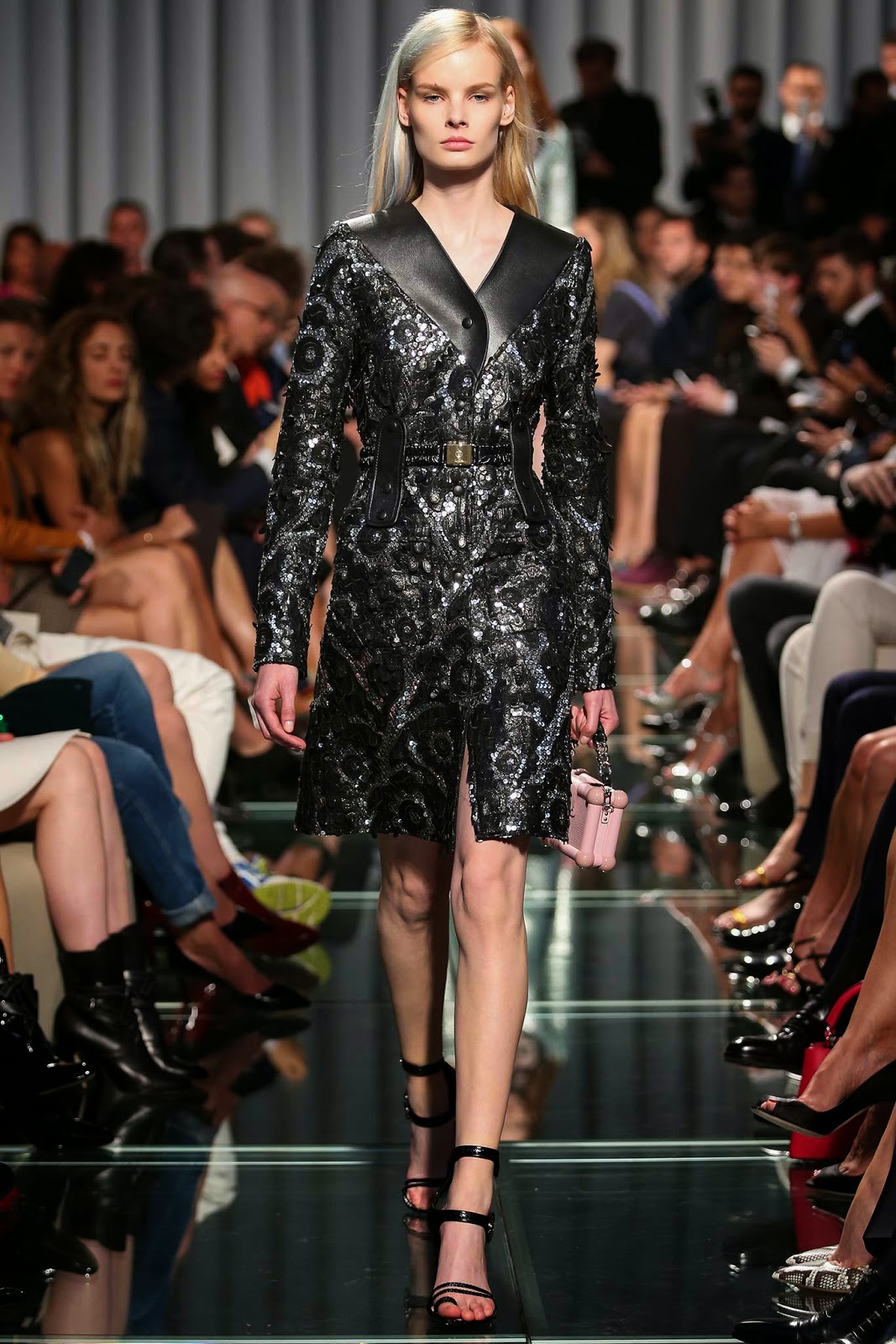
The shows of the last day of Paris Fashion Week all happened long before my morning bus ride, so it was still images that informed my opinion of the Louis Vuitton collection. I'd always enjoyed the drama of Marc Jacobs' tenure at the brand. Each season proving a 180 degree shift from the last. But Nicolas Ghèsquiere has taken a different tack. There is a through line, a growing vision of what he wants the brand to be and the type of woman who wears those clothes.

It's all cool sophistication that references a Parisian style without shouting it from the rooftop.


It has been different work from that which he produced during his tenure at Balenciaga where he sometimes followed a tack similar to that of Jacobs, rockers one season, women from a future not yet imagined in another. However, near the end the themes seemed to be converging.

But in his short time at Louis Vuitton, dramatic swings have been nowhere sight.

Fall 2014


Resort 2015


Spring 2015


Pre-Fall 2015


A center.


Photos via